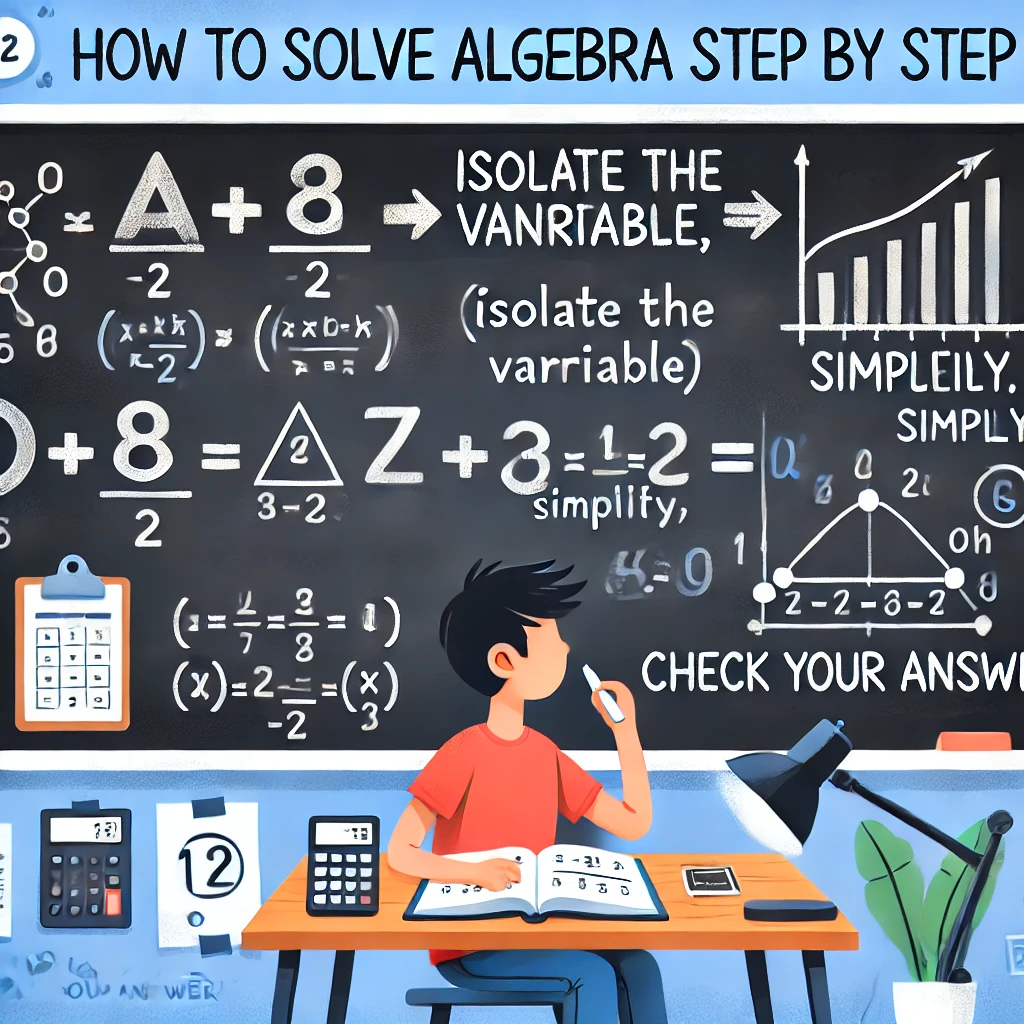
Algebra Problems
Algebra can seem challenging at first, but with a clear and organized approach, solving problems becomes much easier. Follow these step-by-step instructions to tackle algebra problems confidently and accurately.
Step 1: Understand the Problem
Before jumping into calculations, take a moment to read and understand the problem thoroughly.
- Identify the variables (e.g., x, y, or z).
- Determine what the problem is asking you to solve.
- Look for keywords like “sum,” “difference,” “product,” or “quotient” that describe operations.
Example: Solve for x in the equation: 3x + 5 = 20.
Step 2: Simplify Both Sides of the Equation
Simplify the equation by combining like terms and clearing out parentheses if needed.
- Perform operations like addition or multiplication wherever possible.
- Rewrite the equation to make it cleaner.
Example: If the equation is 2(x + 4) = 16, simplify it:
- Distribute the 2: 2x + 8 = 16.
Step 3: Isolate the Variable
The goal in algebra is to solve for the unknown variable. To do this, isolate it on one side of the equation.
- Use inverse operations (e.g., subtract if there’s addition, divide if there’s multiplication).
- Whatever you do to one side, do the same to the other to maintain balance.
Example: In 3x + 5 = 20:
- Subtract 5 from both sides: 3x = 15.
- Divide both sides by 3: x = 5.
Step 4: Check for Additional Steps
If the equation is more complex, repeat steps to further simplify and isolate the variable. For example, with quadratic equations or equations involving fractions:
- For fractions: Multiply through by the least common denominator (LCD).
- For quadratics: Factorize, complete the square, or use the quadratic formula as needed.
Example with Fractions: Solve x/2 + 3 = 7:
- Subtract 3: x/2 = 4.
- Multiply both sides by 2: x = 8.
Step 5: Verify Your Solution
Always substitute your solution back into the original equation to check for accuracy.
- Plug the value of the variable into the equation.
- Simplify both sides to ensure they are equal.
Example: If x = 5 for the equation 3x + 5 = 20, substitute:
- 3(5) + 5 = 20.
- 15 + 5 = 20. It’s correct!
Step 6: Practice with Word Problems
Word problems often require translating sentences into algebraic equations.
- Identify what the variable represents.
- Write an equation based on the relationships described in the problem.
Example: A number increased by 7 is 15. Find the number.
- Let x be the number.
- Equation: x + 7 = 15.
- Solve: Subtract 7 from both sides, x = 8.
Tips for Success
- Work Neatly: Write out each step clearly to avoid mistakes.
- Double-Check Signs: Watch out for negative signs, especially when subtracting or multiplying.
- Practice Regularly: The more problems you solve, the more comfortable you’ll become with patterns and techniques.
steps and practicing consistently, solving algebra problems will become second nature. Whether it’s a simple equation or a complex problem, breaking it into manageable parts is the key to success!
Добавить комментарий