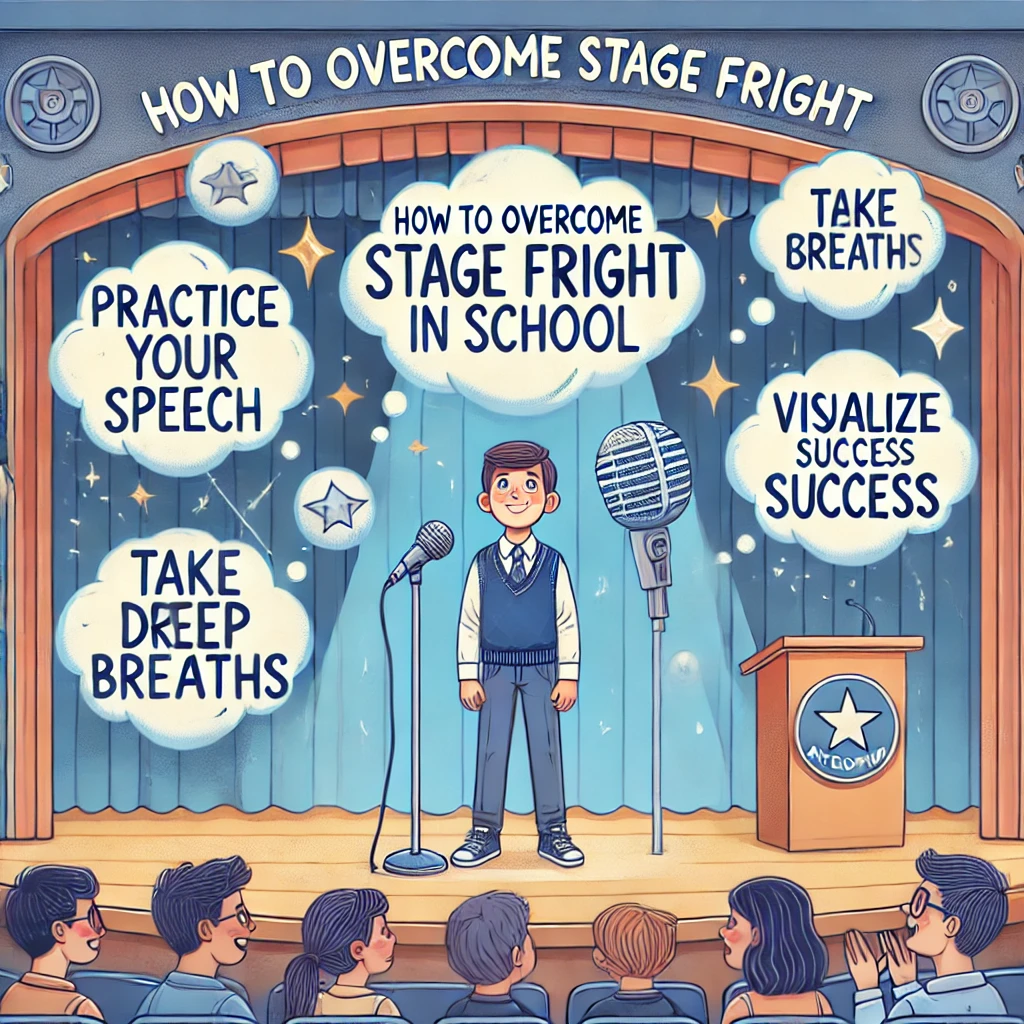
Overcome Stage Fright
Stage fright is a common experience, especially when presenting in front of classmates, performing in a school play, or participating in a debate. While it can feel overwhelming, there are effective strategies to manage your fear and boost your confidence. Here’s how to overcome stage fright and perform your best in school.
1. Understand Stage Fright
Why It’s Important:
Knowing what stage fright is helps you address it.
What Happens:
- Your body activates the “fight or flight” response, causing rapid heartbeat, sweating, or shaky hands.
- These feelings are natural and show that you care about your performance.
Tip: Remind yourself that stage fright is common—even professional performers experience it!
2. Prepare Thoroughly
Why It’s Important:
Preparation reduces anxiety and builds confidence.
How to Do It:
- Practice Regularly: Rehearse your lines, speech, or performance multiple times.
- Know Your Material: Understand your content so you can speak naturally, even if you forget parts.
- Simulate the Environment: Practice in front of friends, family, or a mirror to mimic the real setting.
Tip: Record yourself practicing and review it to identify areas for improvement.
3. Use Relaxation Techniques
Why It’s Important:
Relaxation calms your mind and reduces physical symptoms of anxiety.
Techniques to Try:
- Deep Breathing: Inhale deeply for 4 seconds, hold for 4 seconds, and exhale for 6 seconds. Repeat.
- Progressive Muscle Relaxation: Tense and release each muscle group, starting from your toes to your head.
- Visualization: Picture yourself performing confidently and receiving applause.
Tip: Take a few deep breaths right before you go on stage to center yourself.
4. Focus on Your Audience
Why It’s Important:
Shifting your focus to the audience makes you less self-conscious.
How to Do It:
- Remember, your audience wants you to succeed.
- Make eye contact with friendly faces in the crowd.
- Treat the presentation or performance as a conversation, not a performance.
Tip: Imagine you’re speaking to just one or two friends rather than a large group.
5. Start Small and Build Confidence
Why It’s Important:
Gradual exposure helps you get comfortable with being in the spotlight.
How to Do It:
- Participate in smaller activities, like reading aloud in class.
- Volunteer for low-pressure roles, such as introducing a speaker or presenting in a small group.
- Gradually work your way up to larger performances or presentations.
Tip: Celebrate small victories along the way to boost your confidence.
6. Use Positive Self-Talk
Why It’s Important:
Your mindset plays a big role in overcoming fear.
How to Do It:
- Replace negative thoughts like “I’ll mess up” with positive ones like “I’ve got this!”
- Remind yourself of past successes to build confidence.
- Say affirmations like:
- “I am prepared and capable.”
- “It’s okay to make mistakes; I’ll recover.”
Tip: Write positive statements on sticky notes and place them where you’ll see them daily.
7. Engage Your Body
Why It’s Important:
Physical activity can release nervous energy and improve focus.
How to Do It:
- Stretch or move around before your performance to loosen up.
- Use gestures and body language while presenting to channel nervous energy constructively.
- Stand with good posture—it makes you feel and appear confident.
Tip: Avoid standing completely still; small, natural movements keep you grounded.
8. Learn to Manage Mistakes
Why It’s Important:
Mistakes are natural and don’t have to derail your performance.
How to Do It:
- Pause and take a breath if you forget something.
- Improvise if needed—most people won’t notice small errors.
- Laugh it off if appropriate, and continue confidently.
Tip: Remember, the audience is more forgiving than you think.
9. Get Support from Others
Why It’s Important:
Encouragement from peers and mentors boosts your confidence.
How to Do It:
- Ask a teacher or friend for constructive feedback during practice.
- Share your fears with supportive friends—they may have tips to help you.
- Pair up with a friend for group presentations to feel less alone.
Tip: Watch others perform and learn from their techniques.
10. Reflect and Learn
Why It’s Important:
Each experience helps you grow and improve.
How to Do It:
- After the performance, reflect on what went well and what you can improve.
- Write down your feelings before and after the performance to track progress.
- Use each experience as a stepping stone to build your confidence.
Tip: Celebrate your achievements, no matter how small—they’re steps toward conquering stage fright.
Quick Tips for Performance Day
- Arrive early to get comfortable with the space.
- Hydrate and avoid caffeine—it can heighten anxiety.
- Bring notes or prompts if allowed, but avoid relying on them too much.
- Smile—it not only calms you but also makes you appear more confident.
Final Thoughts
Overcoming stage fright in school takes practice, preparation, and a positive mindset. By following these tips, you can face your fears and perform with greater confidence. Remember, it’s okay to feel nervous—it means you care about doing well. The more you practice, the more comfortable you’ll become. Believe in yourself—you’ve got this!
Добавить комментарий