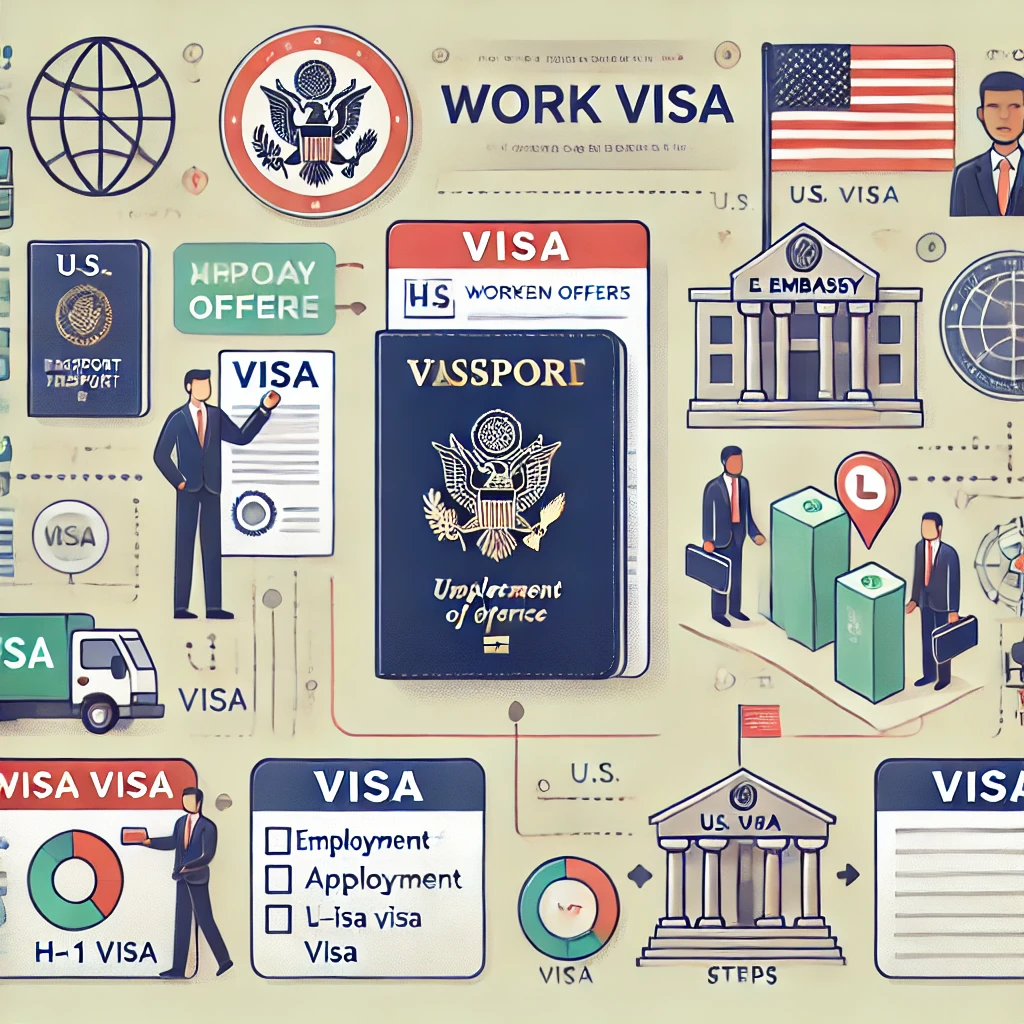
How Does the US Work Visa Process Work?
For foreign nationals interested in working in the United States, obtaining the correct work visa is an essential step. The US work visa process can be complex and time-consuming, as it depends on your qualifications, job type, and the employer sponsoring you. Below, we’ll break down the process, key visa types, and what you need to know to successfully navigate the US work visa system.
1. Understand US Work Visa Categories
The US has several types of work visas, and each is designed for a specific purpose or category of workers. These are divided into two main categories:
a. Nonimmigrant Work Visas
These are temporary visas for individuals who plan to work in the US for a limited time. Examples include:
- H-1B Visa: For highly skilled workers in specialty occupations (e.g., IT, engineering, finance).
- L-1 Visa: For intra-company transfers of executives or employees with specialized knowledge.
- O-1 Visa: For individuals with extraordinary abilities in fields like arts, sciences, education, or business.
- H-2B Visa: For temporary non-agricultural workers (e.g., hospitality, landscaping).
- H-2A Visa: For temporary agricultural workers.
- P-1 Visa: For athletes, entertainers, or performers.
- J-1 Visa: For exchange visitors, including interns, trainees, and researchers.
b. Immigrant Work Visas (Green Cards)
These visas allow individuals to live and work in the US permanently. Examples include:
- EB-1: For individuals with extraordinary abilities or outstanding academic or professional achievements.
- EB-2: For individuals with advanced degrees or exceptional abilities.
- EB-3: For skilled workers, professionals, and unskilled laborers.
- EB-5: For investors who invest a significant amount in a US business and create jobs.
2. The Role of Sponsorship
Most US work visas require an employer to sponsor the applicant. This means the employer:
- Offers a Job: The employer must offer you a position that qualifies for a specific visa.
- Files a Petition: The employer submits a petition to the US Citizenship and Immigration Services (USCIS) on your behalf.
- Meets Legal Requirements: The employer may need to prove that hiring a foreign worker will not negatively impact US workers (e.g., via labor certification).
3. Steps in the US Work Visa Process
Here’s a general overview of how the work visa process works:
Step 1: Find a Sponsoring Employer
- Job Offer: You must secure a job offer from a US-based employer willing to sponsor your visa.
- Agreement: The employer and employee agree on the visa type and terms of employment.
Step 2: Employer Files a Petition
- Petition Filing: For most work visas, the employer submits a petition (e.g., Form I-129) to USCIS.
- Approval Needed: The petition must be approved before you can apply for the visa.
Step 3: Labor Certification (If Required)
- For certain visas (e.g., H-1B, EB-3), the employer must obtain a Labor Certification from the Department of Labor (DOL) to prove that hiring a foreign worker won’t harm US workers.
Step 4: Visa Application
Once the petition is approved:
- Apply for a Visa: Submit a visa application to the US Department of State via Form DS-160 (nonimmigrant visas) or DS-260 (immigrant visas).
- Pay Fees: Visa application fees vary based on the visa type (e.g., $190 for H-1B).
Step 5: Attend Visa Interview
- Schedule an interview at a US Embassy or Consulate in your home country.
- Bring all required documents, including your passport, visa application confirmation, job offer letter, and USCIS petition approval notice.
Step 6: Receive Visa
If your visa is approved, you’ll receive it in your passport, allowing you to travel to the US to work.
4. Key Documents Required
To apply for a US work visa, you’ll need the following documents:
- Valid Passport: Must be valid for at least six months beyond your intended stay in the US.
- Job Offer Letter: A formal offer of employment from the sponsoring employer.
- Form I-797: Approval notice from USCIS (if applicable).
- Visa Application Confirmation: DS-160 or DS-260 confirmation page.
- Proof of Qualifications: Degrees, certifications, or evidence of specialized skills.
- Labor Certification: If applicable, proof that the DOL has approved the employer’s certification request.
5. Processing Time
The time it takes to process a US work visa varies by visa type:
- H-1B Visa: 3–6 months (or 15 days with premium processing).
- L-1 Visa: 1–3 months.
- Green Cards: Several months to years, depending on the visa category and country of origin.
6. H-1B Visa: A Popular Work Visa
The H-1B visa is one of the most sought-after work visas in the US. Here’s how it works:
- Annual Cap: There’s a cap of 65,000 visas per year, with an additional 20,000 visas for individuals with advanced degrees.
- Lottery System: If applications exceed the cap, USCIS uses a lottery system to select petitions.
- Duration: Initially valid for 3 years, extendable to 6 years.
- Path to Green Card: H-1B visa holders can often transition to permanent residency (green card) through employer sponsorship.
7. Can You Work Without a Visa?
In most cases, you cannot legally work in the US without a visa. Exceptions include:
- US Citizens and Permanent Residents: No visa is required.
- Specific Situations: Some visas, like a B-1 Business Visa, allow short-term work-related activities (but not full-time employment).
8. Challenges in the US Work Visa Process
The process can be complex and has several challenges:
- Strict Requirements: Employers must prove a need for foreign workers and meet legal obligations.
- Lengthy Processing Times: Some visas take months or years to process.
- Annual Caps: Popular visas like the H-1B are subject to strict quotas.
- High Costs: Employers often bear the costs of filing fees, labor certifications, and legal representation.
9. Tips for a Successful Work Visa Application
- Start Early: Begin the process as soon as possible to account for processing times.
- Work with Experienced Employers: Companies familiar with sponsoring visas are more likely to navigate the process efficiently.
- Seek Legal Advice: Immigration attorneys can help ensure that your application is accurate and complete.
- Prepare for the Interview: Practice answering questions about your job, qualifications, and intentions in the US.
Final Thoughts
The US work visa process is a detailed and multi-step procedure that requires collaboration between the employer and the foreign worker. While the system can be challenging, understanding the steps and requirements can help you navigate it successfully. Whether you’re applying for a temporary nonimmigrant visa or aiming for permanent residency, thorough preparation and the right guidance are essential to achieving your goal.
For more resources on immigration and navigating the US work visa process, check out helpful guides for actionable insights tailored to your situation.
Добавить комментарий