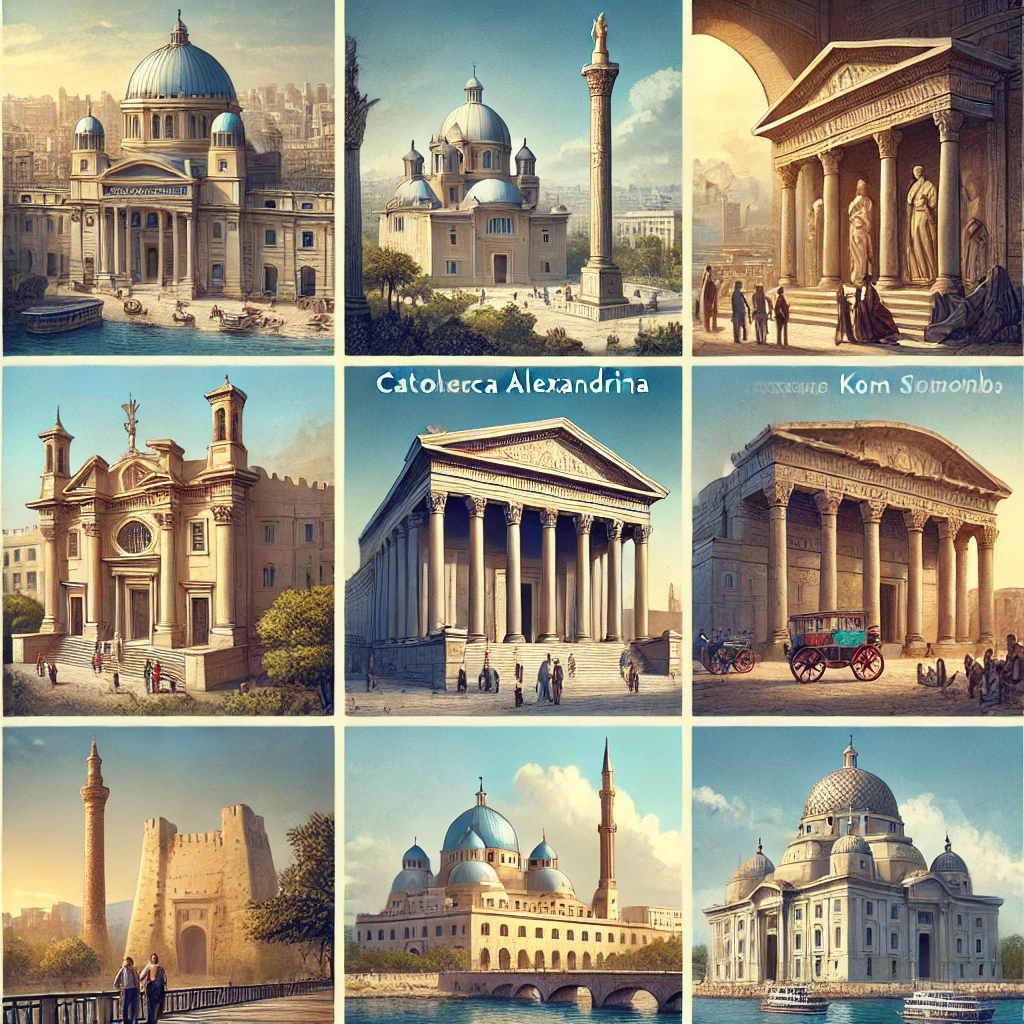
Historic Sites in Alexandria, Egypt
Alexandria, Egypt’s legendary Mediterranean city, is steeped in history, blending ancient wonders with a rich cultural heritage. Founded by Alexander the Great in 331 BCE, the city was once home to the Great Library of Alexandria and the Pharos Lighthouse, one of the Seven Wonders of the Ancient World. Today, visitors can explore its historic sites, which tell the story of Egypt’s Greco-Roman past, Islamic heritage, and colonial influences. Here are the must-visit historic sites in Alexandria.
1. Catacombs of Kom El Shoqafa
- Why Visit? One of the largest and most important burial sites from the Roman era in Egypt.
- Highlights:
- A fascinating mix of Egyptian, Greek, and Roman architectural styles.
- The Main Burial Chamber, featuring relief carvings of Egyptian gods.
- The Hall of Caracalla, believed to be a mass burial site for Roman soldiers.
- Fun Fact: The catacombs were accidentally discovered in 1900 when a donkey fell into a hole!
2. Pompey’s Pillar
- Why Visit? The tallest ancient column in Egypt, standing at 26.8 meters (88 feet).
- History: Built in 297 CE in honor of Emperor Diocletian, this massive column once stood as part of the Serapeum Temple, dedicated to the Greco-Egyptian god Serapis.
- What’s Nearby? Ruins of ancient libraries and underground chambers from the Serapeum.
3. Citadel of Qaitbay
- Why Visit? A stunning 15th-century fortress built on the ruins of the famous Pharos Lighthouse.
- Highlights:
- Panoramic views of the Mediterranean coastline.
- A well-preserved medieval defense system, including cannon placements and watchtowers.
- A small maritime museum showcasing Alexandria’s naval history.
- Interesting Fact: Some of the stones used in the citadel were taken from the collapsed Pharos Lighthouse!
4. Bibliotheca Alexandrina (Modern Library of Alexandria)
- Why Visit? A modern tribute to the ancient Great Library of Alexandria, one of the most famous libraries of antiquity.
- What to See:
- The main reading hall, a massive structure with space for over 8 million books.
- The Manuscript Museum, featuring rare ancient texts.
- A Planetarium and Science Museum for astronomy lovers.
- Must-Know Fact: The original library, founded in the 3rd century BCE, was one of the largest in the ancient world before its destruction.
5. Montaza Palace and Gardens
- Why Visit? A royal palace built by King Fuad I in 1892, later expanded by King Farouk.
- Highlights:
- The Al-Haramlik Palace, blending Ottoman and Florentine architectural styles.
- Beautiful gardens with sea views, perfect for a peaceful stroll.
- Montaza Beach, a scenic spot for relaxation.
- Did You Know? The palace was once a summer retreat for Egypt’s royal family.
6. Roman Amphitheater
- Why Visit? The only Roman amphitheater discovered in Egypt.
- Key Features:
- 13 semi-circular marble terraces, originally used for performances and public gatherings.
- Underground Roman baths and mosaics.
- Artifacts from the Byzantine and early Islamic periods.
- Best Time to Visit: Early morning to avoid crowds and fully enjoy the site.
7. Abu al-Abbas al-Mursi Mosque
- Why Visit? One of the most beautiful and historic mosques in Egypt, dedicated to Abu al-Abbas al-Mursi, a 13th-century Andalusian Sufi saint.
- Architectural Highlights:
- Massive domes and towering minarets, inspired by Mamluk and Ottoman designs.
- Stunning Islamic calligraphy and intricate geometric patterns inside.
- A serene courtyard, ideal for quiet reflection.
- Tip: Visitors should dress modestly when entering the mosque.
8. Anfushi Tombs
- Why Visit? A lesser-known but fascinating set of Ptolemaic-era tombs dating back to 250 BCE.
- What Makes It Special?
- Greek-style frescoes and Egyptian motifs, showing the fusion of cultures in ancient Alexandria.
- Burial chambers carved into limestone, with intricate decorations.
- Best For: History buffs looking for an off-the-beaten-path experience.
9. Ras El Tin Palace
- Why Visit? One of Egypt’s oldest royal palaces, built in the early 19th century by Muhammad Ali Pasha.
- What to See:
- The stunning white façade overlooking the Mediterranean.
- Lush gardens and historical interiors (though the palace itself is not always open to the public).
- Historical Significance: This was where King Farouk, Egypt’s last monarch, was exiled in 1952 before abdicating the throne.
10. Stanley Bridge
- Why Visit? A modern landmark that captures the essence of Alexandria’s Mediterranean charm.
- Why It’s Special:
- A beautifully designed bridge offering panoramic views of the sea.
- A great spot for photography, especially at sunset.
- Close to many beachfront cafés and seafood restaurants.
- Fun Fact: Stanley Bridge was Egypt’s first modern bridge built over the sea.
Why Visit Alexandria’s Historic Sites?
Alexandria’s history is a blend of Egyptian, Greek, Roman, and Islamic influences, making it one of the most fascinating cities to explore. From ancient catacombs to modern marvels, this coastal city offers an unforgettable journey through time.
For more tips on improving your photography and editing skills, check out helpful guides to take your selfies to the next level.
Добавить комментарий