Project Ideas
Science fair projects are an exciting way to explore the wonders of science while having fun and learning something new. Whether you’re a beginner or just looking for simple ideas, there are plenty of easy science fair project ideas that you can complete with everyday materials. In this article, we’ll explore projects that are easy to set up, engaging, and guaranteed to impress at your next science fair.
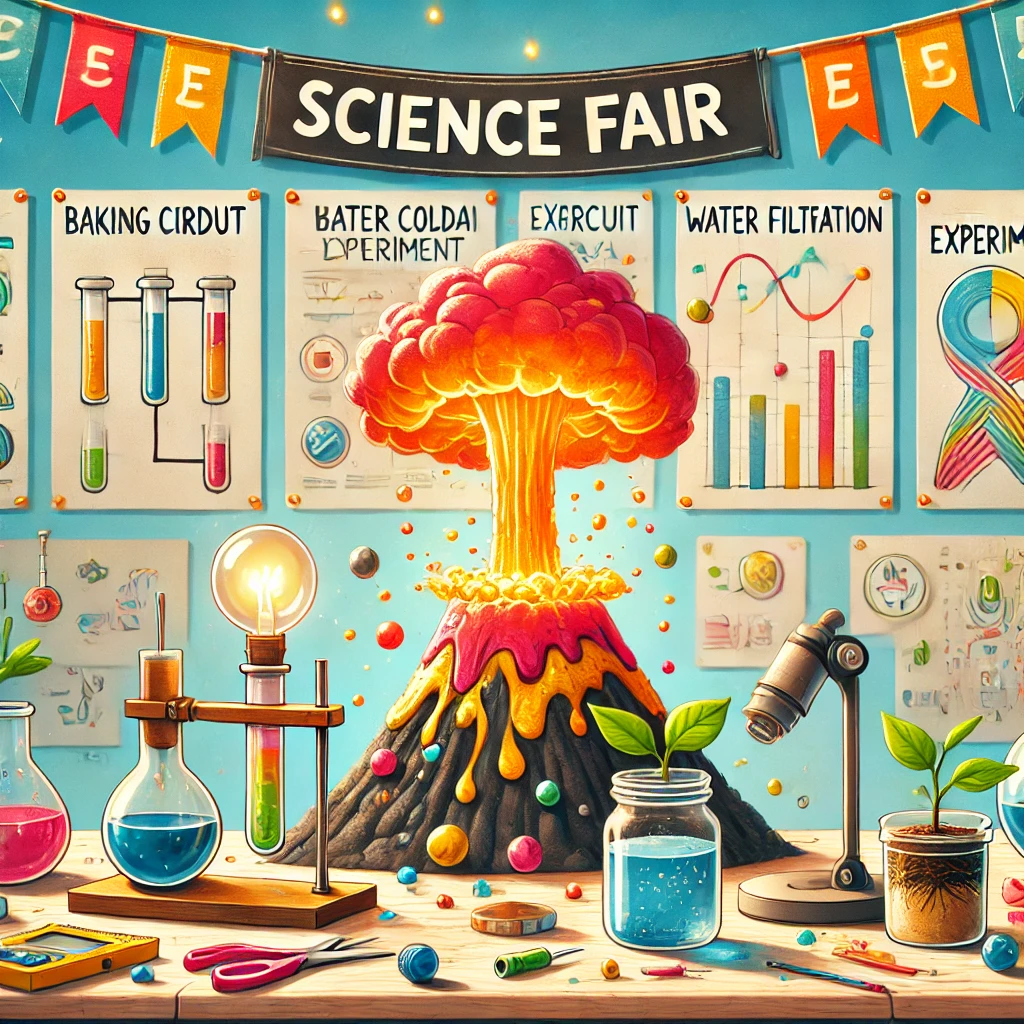
1. Baking Soda and Vinegar Volcano
Why It’s a Great Science Fair Project:
This classic experiment is both fun and educational, making it a popular choice for any science fair project.
Materials:
-
- Baking soda
- Vinegar
- Dish soap
- Food coloring
- Plastic bottle
- Cardboard or clay for the volcano structure
Procedure:
- Build a simple volcano structure using clay or cardboard around a plastic bottle.
- Fill the bottle halfway with vinegar.
- Add a few drops of dish soap and food coloring for effect.
- Add a tablespoon of baking soda, and watch your volcano erupt!
Scientific Principle: This project demonstrates an acid-base reaction that produces carbon dioxide gas, simulating a volcanic eruption.
2. Rainbow in a Glass
Why It’s Perfect for a Science Fair Project:
This colorful and easy experiment demonstrates the concept of liquid density in a visually stunning way.
Materials:
- Sugar
- Food coloring
- Water
- Glasses
Procedure:
- Mix varying amounts of sugar (e.g., 1 tablespoon, 2 tablespoons) into separate glasses of water.
- Add food coloring to each solution.
- Carefully layer the liquids into one glass using a spoon.
Scientific Principle: Liquids with higher sugar content are denser, allowing them to stack without mixing.
3. Lemon Battery
A Unique Science Fair Project:
Turn lemons into a source of electricity with this easy science fair project that demonstrates chemical reactions.
Materials:
- Lemons
- Copper coins
- Zinc nails
- Wires with alligator clips
- LED light
Procedure:
- Insert a copper coin and a zinc nail into each lemon.
- Connect the lemons in a series using wires.
- Attach the wires to an LED light to complete the circuit.
Scientific Principle: The acid in the lemons facilitates an electrochemical reaction, generating enough energy to power the LED light.
4. Walking Water Experiment
A Simple Yet Fascinating Science Fair Project:
Show how water can move on its own using capillary action.
Materials:
- Water
- Food coloring
- Paper towels
- Glasses
Procedure:
- Fill two glasses with water and leave one empty in between.
- Add food coloring to the water-filled glasses.
- Place a folded paper towel between each pair of glasses.
- Watch as water “walks” into the empty glass.
Scientific Principle: Capillary action allows water to travel through the fibers of the paper towel, creating a self-moving effect.
5. Balloon-Powered Car
An Entertaining Science Fair Project:
Explore propulsion and motion with this fun and creative science fair project.
Materials:
- Balloon
- Straw
- Tape
- Cardboard for the car base
- Bottle caps for wheels
Procedure:
- Construct a small car using cardboard and bottle caps.
- Attach a straw to a balloon and secure it to the car.
- Inflate the balloon, seal the straw, and release it to propel the car forward.
Scientific Principle: Newton’s Third Law of Motion states that every action has an equal and opposite reaction. The air escaping the balloon pushes the car forward.
6. Egg Float Test
A Quick and Easy Science Fair Project:
Learn how salt affects water density with this simple experiment.
Materials:
- Eggs
- Salt
- Glasses
- Water
Procedure:
- Fill one glass with plain water and another with saltwater.
- Place an egg in each glass and observe the results.
Scientific Principle: Adding salt increases the water’s density, making the egg float.
7. Homemade Lava Lamp
A Bright Idea for a Science Fair Project:
This simple project combines art and science to create a mesmerizing lava lamp effect.
Materials:
- Clear bottle or jar
- Vegetable oil
- Water
- Food coloring
- Alka-Seltzer tablets
Procedure:
- Fill a bottle with oil and water, leaving some space at the top.
- Add food coloring to the water layer.
- Drop in an Alka-Seltzer tablet and watch the bubbles rise and fall.
Scientific Principle: This project illustrates the difference in densities between oil and water while showing how gas creates motion.
8. Solar Oven
A Warm and Bright Science Fair Project:
Harness the power of the sun to cook a snack with this hands-on experiment.
Materials:
- Cardboard box
- Aluminum foil
- Plastic wrap
- Black construction paper
- Marshmallows
Procedure:
- Line the inside of the box with black paper.
- Cover the lid with aluminum foil to reflect sunlight.
- Seal the box with plastic wrap and place marshmallows inside.
- Set the box in direct sunlight and observe as the marshmallows melt.
Scientific Principle: Solar energy is absorbed by the black paper and reflected by the foil, heating the air inside the box.
These easy science fair project ideas are simple, educational, and sure to impress at your next science fair. By experimenting with concepts like chemical reactions, density, and propulsion, you’ll not only complete a successful science fair project but also gain valuable knowledge along the way!
Добавить комментарий