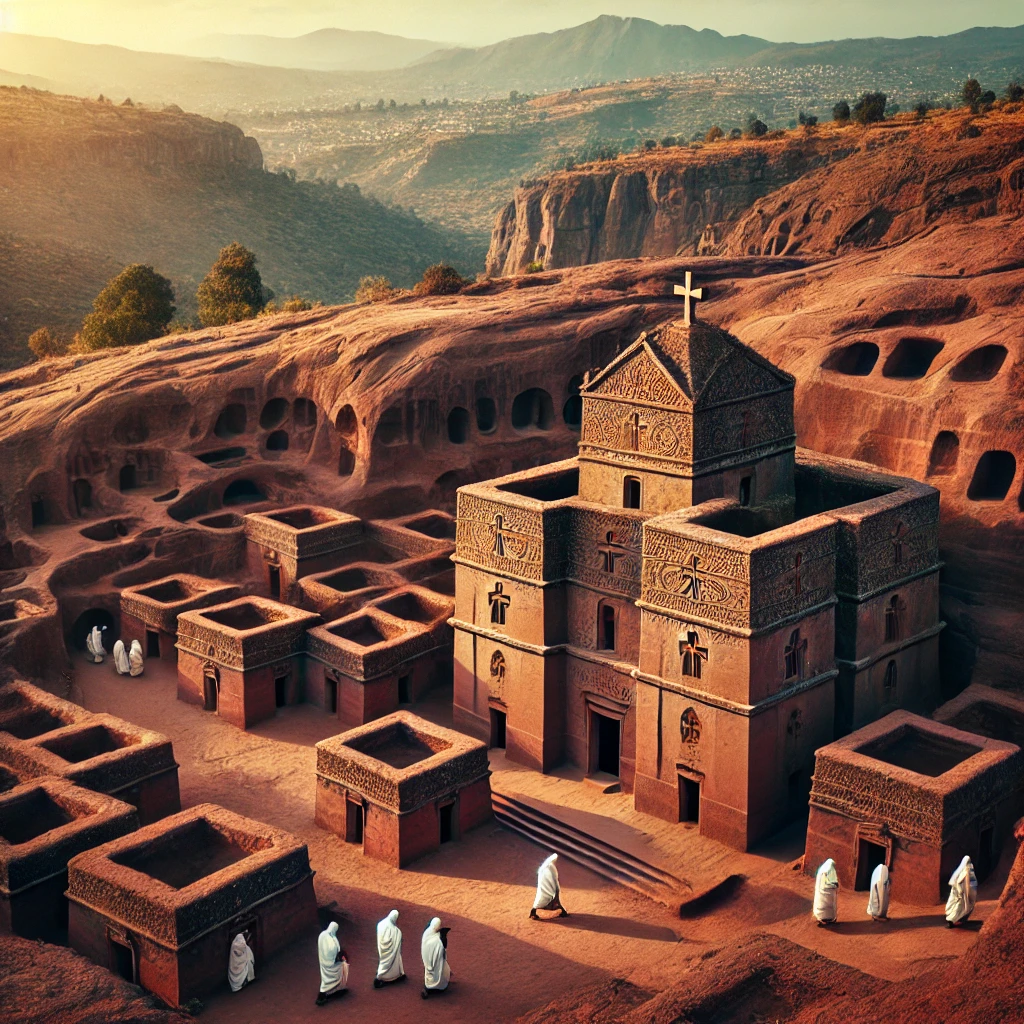
Lalibela Rock-Hewn Churches in Ethiopia
The rock-hewn churches of Lalibela are one of Ethiopia’s most extraordinary historical and religious sites. Carved directly into solid rock, these medieval churches are a UNESCO World Heritage Site and remain an important pilgrimage destination for Ethiopian Orthodox Christians. Often referred to as the «New Jerusalem,» Lalibela’s churches are a testament to the ingenuity, devotion, and artistry of Ethiopia’s ancient civilizations.
1. History and Significance
- Built in the 12th–13th century under the reign of King Lalibela, who sought to create a «Jerusalem of Africa.»
- The churches were carved from volcanic rock and connected by tunnels and passageways.
- Today, they remain active places of worship, attracting thousands of pilgrims each year.
2. The 11 Rock-Hewn Churches
The churches are divided into two groups, separated by a symbolic «River Jordan.»
Northern Cluster
- Biete Medhane Alem – The largest rock-hewn church in the world, housing the replica of the Ark of the Covenant.
- Biete Maryam – One of the oldest, adorned with beautiful frescoes.
- Biete Golgotha Mikael – Believed to hold the tomb of King Lalibela himself.
- Biete Meskel – Smaller but significant in religious rituals.
- Biete Denagel – A tribute to the martyred Christian women.
Southern Cluster
- Biete Amanuel – Thought to have been a royal chapel.
- Biete Abba Libanos – Partially separated from the rock, with legend saying it was built overnight by angels.
- Biete Gabriel-Rufael – Possibly a former royal palace.
- Biete Lehem – Meaning «House of Bread,» associated with the Holy Eucharist.
- Biete Mercurios – Believed to be a former prison.
The Most Iconic Church
- Biete Giyorgis (Church of St. George) – The most famous and visually striking, shaped like a perfect cross, standing alone and surrounded by trenches.
3. Architectural Marvel and Construction
- The churches were not built, but excavated, with workers carving from the top down.
- Many feature intricate pillars, arches, and windows, all sculpted directly from the rock.
- Inside, there are frescoes, crosses, and sacred artifacts that have been preserved for centuries.
4. Religious and Cultural Importance
- Lalibela remains a major pilgrimage site, especially during religious festivals like Genna (Ethiopian Christmas).
- Ethiopian Orthodox priests conduct daily services, dressed in traditional white robes and carrying ceremonial crosses.
5. Visiting Lalibela
- Best Time to Visit: October to March (dry season).
- Getting There: Flights from Addis Ababa or a scenic drive through Ethiopia’s highlands.
- Cultural Experience: Witness ancient religious ceremonies, hear traditional chanting, and explore the surrounding monasteries.
A Timeless Wonder
The rock-hewn churches of Lalibela are more than just historical monuments—they are living spiritual centers, showcasing Ethiopia’s deep faith, artistry, and architectural genius. A visit to Lalibela is a journey back in time, offering an unforgettable glimpse into one of Africa’s most sacred places.
For more tips on improving your photography and editing skills, check out helpful guides to take your selfies to the next level.
Добавить комментарий