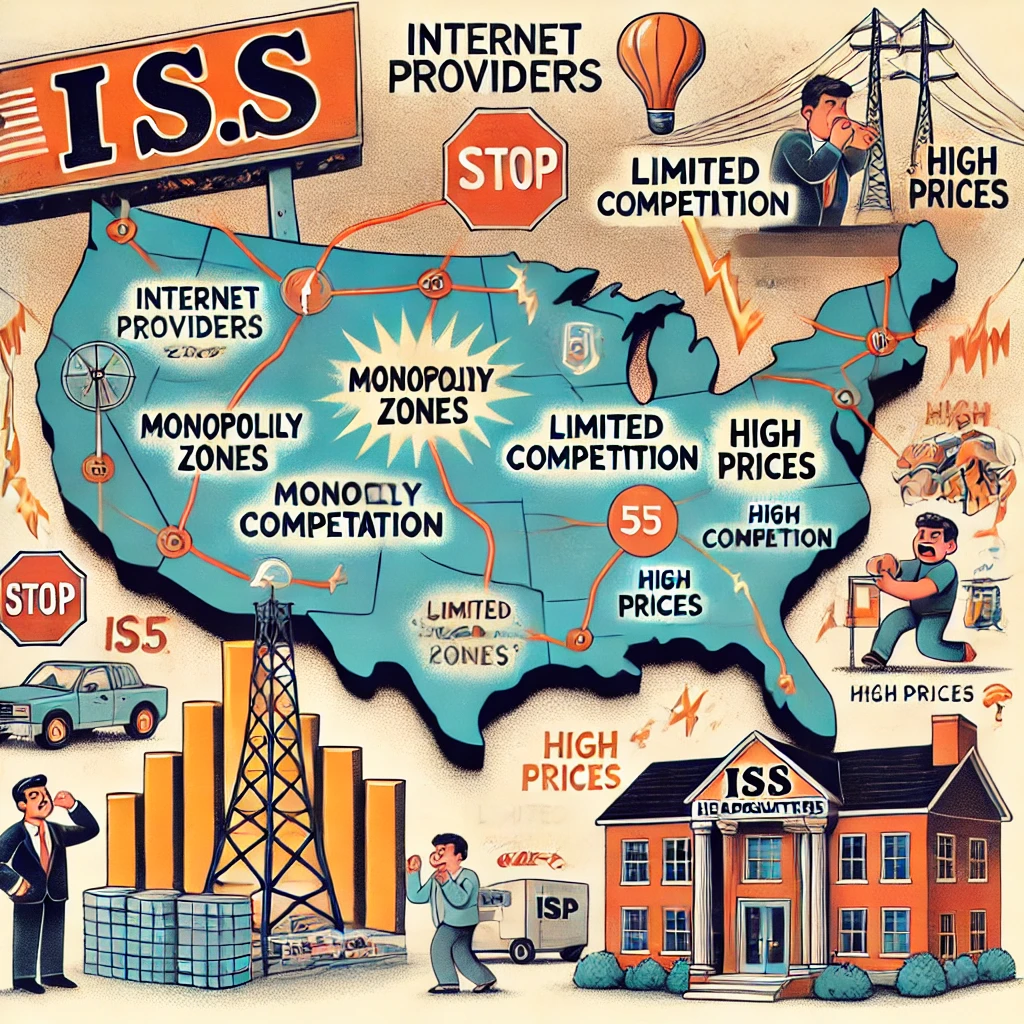
Why Are US Internet Providers So Limited?
If you’ve ever felt frustrated by the lack of choices when it comes to internet service providers (ISPs) in the United States, you’re not alone. Many Americans face limited options for broadband providers, often having just one or two companies to choose from. This lack of competition leads to higher prices, slower speeds, and poorer service compared to other developed countries. So, why are US internet providers so limited? Let’s dive into the main reasons behind this issue.
1. Monopolies and Duopolies Dominate the Market
One of the primary reasons for limited options is that the US broadband market is dominated by monopolies or duopolies in most areas.
- Regional Control: Many ISPs, like Comcast, AT&T, or Spectrum, carve out territories where they face little to no competition.
- Exclusive Coverage: In some areas, one company may be the only provider of broadband, giving them total control over pricing and service quality.
- Shared Market Spaces: In urban areas, you might see two major competitors (a duopoly) offering internet services, but they rarely compete aggressively on price or service.
Without true competition, these companies have little incentive to improve or lower costs.
2. Expensive Infrastructure Investment
Building and maintaining internet infrastructure, especially in a country as large as the US, is incredibly costly.
- High Costs for Expansion: ISPs must lay cables, install equipment, and build networks to deliver broadband. This is particularly expensive in rural or remote areas with fewer customers to recoup the investment.
- Barrier to Entry for New Providers: Smaller companies or startups often lack the capital needed to compete with established ISPs on a large scale.
- Focus on Profitable Areas: ISPs prioritize urban and suburban areas with higher populations, leaving rural areas underserved or with no service at all.
3. Lack of Government Regulation and Oversight
The US government has taken a hands-off approach to regulating ISPs, allowing monopolistic behavior to persist.
- Weak Competition Policies: Antitrust laws that prevent monopolies in other industries are not strongly enforced in the broadband market.
- Net Neutrality Repeal: The 2017 repeal of net neutrality weakened protections for consumers and allowed ISPs to prioritize profits over quality of service.
- Local Franchise Agreements: Some municipalities sign exclusive agreements with a single ISP, further limiting competition in those areas.
In contrast, countries with faster, cheaper broadband often have stronger government oversight and policies to encourage competition.
4. Geographic Challenges
The size and geography of the US make it difficult to provide consistent and widespread broadband access.
- Low Population Density in Rural Areas: Sparsely populated regions require significant investment to build infrastructure for relatively few customers, making it less attractive for ISPs.
- Difficult Terrain: Mountains, deserts, and other challenging terrains make it even more expensive to lay fiber-optic cables or build necessary infrastructure.
As a result, ISPs often avoid rural areas entirely or rely on slower, outdated technology like DSL or satellite.
5. Lack of Municipal Broadband Networks
Municipal broadband, where cities and towns provide internet service to residents, has proven successful in several areas but is not widespread.
- Examples of Success: Cities like Chattanooga, Tennessee, and Wilson, North Carolina, have built municipal networks offering affordable, high-speed internet.
- Barriers to Expansion: Many states have laws, often lobbied for by ISPs, that restrict or outright ban municipal broadband projects.
- Why It Matters: Municipal networks could provide competition in underserved areas, but restrictions protect large ISPs from losing market share.
6. Limited Fiber-Optic Rollout
Fiber-optic internet is the gold standard for high-speed broadband, but its rollout in the US has been slow and uneven.
- High Upfront Costs: Fiber requires significant investment to install, and ISPs prioritize profitable urban areas over less-populated regions.
- Cable Infrastructure Dominance: Many areas still rely on older coaxial cable networks, which are slower than fiber and less future-proof.
- Private Sector Dependence: Unlike some countries where governments fund fiber deployment, the US relies on private companies to expand fiber networks, leading to slower progress.
7. Industry Consolidation
The US broadband market has seen significant consolidation, with a few large companies acquiring smaller competitors.
- Fewer Choices: Mergers and acquisitions reduce the number of independent providers, leaving consumers with fewer options.
- Increased Market Power: Consolidated ISPs can dictate prices and service quality without fear of losing customers to competitors.
- Examples: Mergers like Comcast’s acquisition of NBCUniversal and Charter’s merger with Time Warner Cable have further concentrated power among a handful of companies.
8. Focus on Profit Over Service
US ISPs operate as profit-driven corporations, and their primary focus is maximizing shareholder value rather than providing universal access or affordable service.
- Urban Focus: ISPs prioritize dense, urban markets where they can generate the most profit per customer.
- Slow Upgrades: Companies may delay upgrading infrastructure if the current setup remains profitable, even if it results in slower speeds for customers.
- Data Caps: Many ISPs impose data caps or charge extra fees for higher usage, further maximizing revenue at the expense of customers.
9. Inconsistent Rural Internet Solutions
For rural areas, the lack of broadband options is especially pronounced.
- Satellite Internet: While providers like Starlink and HughesNet are expanding satellite internet, speeds and latency often fall short of fiber or cable.
- Outdated Technology: DSL, which relies on telephone lines, is still the only option in many rural areas despite being much slower than modern alternatives.
- Government Subsidies: Programs like the Rural Digital Opportunity Fund aim to improve rural access, but progress has been slow and uneven.
10. Comparison to Other Countries
In countries like South Korea, Japan, and Sweden, internet access is faster, cheaper, and more widely available.
- Government Involvement: Many countries treat broadband as a utility, with government-funded infrastructure ensuring universal access.
- Smaller Geography: Countries with smaller land areas can deploy infrastructure more efficiently.
- Competition: ISPs in other countries often face stronger competition, driving down prices and improving service quality.
How Can the US Improve Broadband Access?
Addressing the limited availability of ISPs in the US requires both public and private efforts:
- Increase Competition: Break up monopolies and encourage new providers to enter the market.
- Expand Fiber Networks: Invest in fiber-optic infrastructure, particularly in underserved areas.
- Support Municipal Broadband: Remove restrictions on city-run broadband networks to increase local competition.
- Strengthen Regulations: Enforce stricter rules to prevent anti-competitive behavior by ISPs.
- Improve Rural Access: Fund initiatives that expand broadband to rural and remote areas.
Final Thoughts
The limited choice of internet providers in the US stems from a mix of monopolistic practices, high infrastructure costs, weak regulation, and geographic challenges. While some progress is being made, significant changes are needed to increase competition, lower prices, and improve service quality for all Americans.
For more insights into technology and cost-saving tips, check out helpful guides to navigate the challenges of modern internet access.
Добавить комментарий