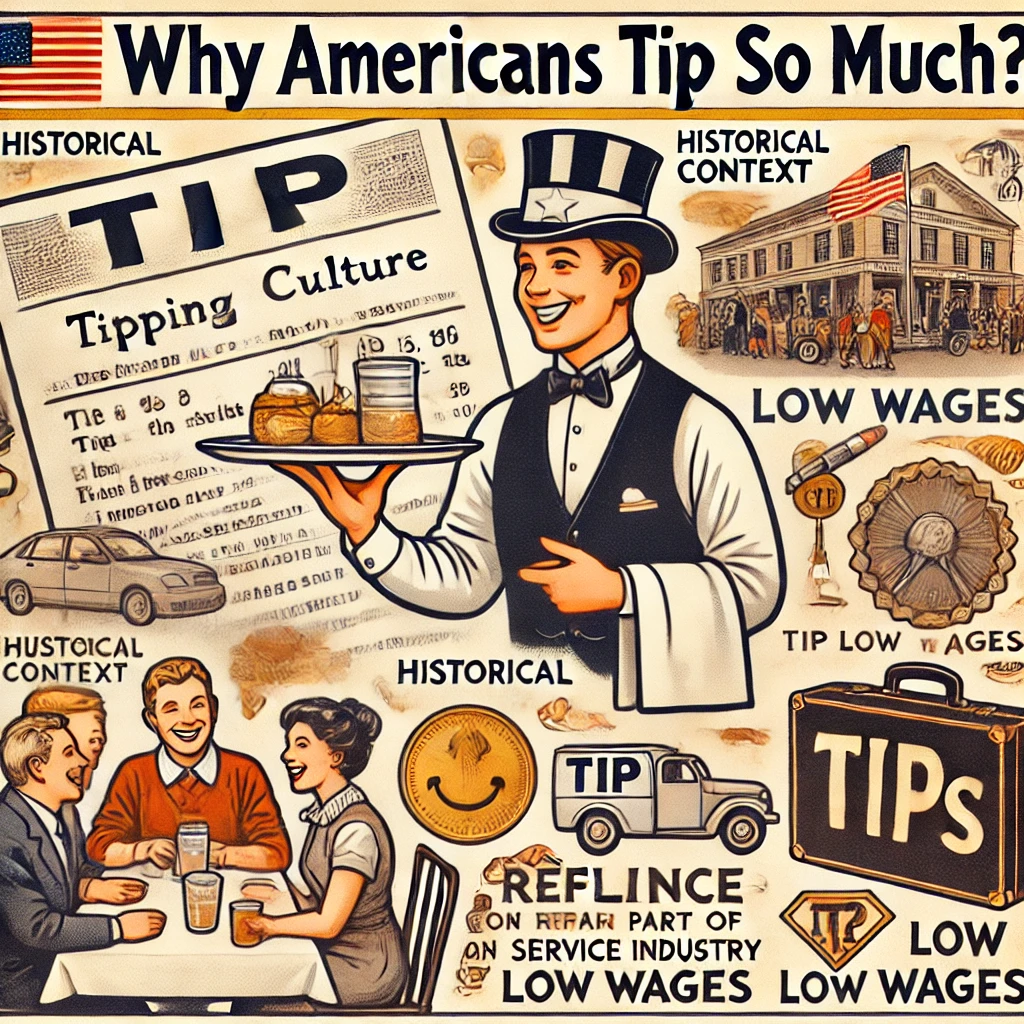
Americans Tip
Tipping is a deeply ingrained cultural practice in the United States, and it often surprises visitors from countries where tipping is either minimal or not expected at all. In America, tips are not just a gesture of appreciation—they’re often essential for workers’ income. But why do Americans tip so much, and how did this custom become so widespread? Here’s a deep dive into the reasons behind America’s tipping culture.
1. Tipping Makes Up for Low Wages
One of the primary reasons Americans tip so much is because tipping is built into the wage system for many service workers.
- Tipped Minimum Wage: Federal law allows employers to pay tipped workers as little as $2.13 per hour (compared to the standard federal minimum wage of $7.25 per hour), under the assumption that tips will make up the difference.
- Income Dependency: For workers like servers, bartenders, and delivery drivers, tips can account for 50-90% of their total earnings. Without tips, many would struggle to make a living wage.
- No Mandatory Service Charge: Unlike in some countries where service charges are automatically added to the bill, tipping in the US is discretionary, which places responsibility on the customer to supplement wages.
2. Historical Roots of Tipping in America
The tipping culture in the US has historical roots dating back to the late 19th and early 20th centuries.
- Imported from Europe: Tipping originated in Europe and was brought to the US by wealthy Americans who had traveled abroad. Initially, it was seen as a way to show off wealth and status.
- Post-Slavery Practices: After the abolition of slavery, tipping became widespread in certain industries like hospitality and railroads as a way for employers to avoid paying Black workers fair wages. These workers were often expected to rely entirely on tips, a practice that has influenced wage policies to this day.
3. Service Industry Norms and Expectations
In the US, tipping is seen as a reward for good service, and workers are often trained to provide a higher level of attentiveness and friendliness to earn better tips.
- Personalized Service: Waitstaff and bartenders in the US often engage in more personalized, attentive service compared to other countries. This expectation encourages customers to tip generously as a way of saying thank you.
- Incentive for Quality: Since tips are tied to service quality, workers are motivated to provide exceptional experiences to maximize their earnings.
4. Social Pressure and Cultural Norms
Tipping has become so ingrained in American culture that it’s often seen as a social obligation rather than an optional gesture.
- Avoiding Awkwardness: Many Americans tip because they don’t want to appear rude or stingy. Leaving no tip, or a very small one, can be seen as a strong statement of dissatisfaction with the service.
- Social Norms: In restaurants, a tip of 15-20% is the standard, with 20% being increasingly common. Anything less is considered poor etiquette, even if the service wasn’t exceptional.
- Peer Influence: Americans grow up observing tipping behavior, so it becomes second nature. Dining with others often reinforces the expectation to tip appropriately.
5. Wide Range of Tipping Situations
In the US, tipping extends beyond restaurants and bars to a variety of services, further increasing the overall tipping amounts.
- Common Tipping Situations:
- Hairdressers and barbers (15-20%)
- Taxi and rideshare drivers (10-20%)
- Hotel staff, including housekeeping and bellhops ($2-$5 per service)
- Food delivery drivers (15-20% or $3-$5 minimum)
- Service Economy: The US has a large service-based economy where tipping is customary in most personal service industries, which adds up quickly for customers.
6. Lack of Government Intervention
Unlike in many countries where service charges are standardized or tipping is included in the bill, the US government allows tipping to remain a voluntary practice.
- Employer Reliance on Tipping: Employers in the US benefit from tipping because it shifts the burden of paying fair wages onto the customer. This reduces labor costs for businesses.
- No Mandatory Service Fees: While some restaurants have experimented with eliminating tipping and paying workers higher wages, most revert to tipping due to customer resistance or increased menu prices.
7. Psychological Factors Behind Tipping
Tipping in America is often influenced by psychological and emotional factors.
- Guilt and Gratitude: Many people tip out of guilt, especially when face-to-face with the person providing the service. A tip becomes a way to express gratitude.
- Reciprocity: Tipping reinforces the idea of giving something in return for good service, creating a transactional relationship.
- Social Approval: Generous tipping is sometimes seen as a way to show kindness or generosity, which boosts the tipper’s self-image.
8. Economic Inequality and Regional Differences
The tipping culture also reflects broader economic realities and varies based on location.
- Economic Inequality: In areas with high costs of living, tipping generously may feel more necessary to help service workers make ends meet.
- Regional Variations: Tipping norms vary across the US. For example:
- In urban areas like New York City or San Francisco, tips of 20-25% are common.
- In smaller towns or less tourist-heavy regions, tips of 15-18% may still be standard.
9. Comparison to Other Countries
The US tipping culture contrasts sharply with practices in many other countries:
- Europe: Tipping is often included as a service charge in the bill (usually 5-10%), and additional tips are optional.
- Japan: Tipping is rare and can even be considered rude, as excellent service is seen as part of the job.
- Australia and New Zealand: Workers earn higher base wages, so tipping is minimal or nonexistent.
The US reliance on tipping stems from a combination of its wage system and cultural expectations, making it stand out globally.
10. The Debate Around Tipping Culture
Tipping culture in America is not without controversy, as many argue that it places an unfair burden on customers and service workers.
- Criticisms:
- Tipping can be unpredictable and creates income instability for workers.
- Customers often feel obligated to tip even for mediocre service.
- It perpetuates a system where businesses can underpay workers.
- Alternative Models: Some advocates push for higher minimum wages or a “no-tipping” system, where service charges are included in the bill and workers receive fair pay.
Final Thoughts
Americans tip so much because tipping is embedded in the nation’s wage structure, cultural norms, and expectations of service quality. While it may seem excessive to outsiders, tipping in the US is a reflection of the broader economic and historical forces that shape the service industry. Though there’s growing debate around whether tipping should continue as the standard, for now, it remains an essential part of American life.
For more insights into US culture and cost-saving tips, check out helpful guides to better navigate American practices and etiquette.
Добавить комментарий