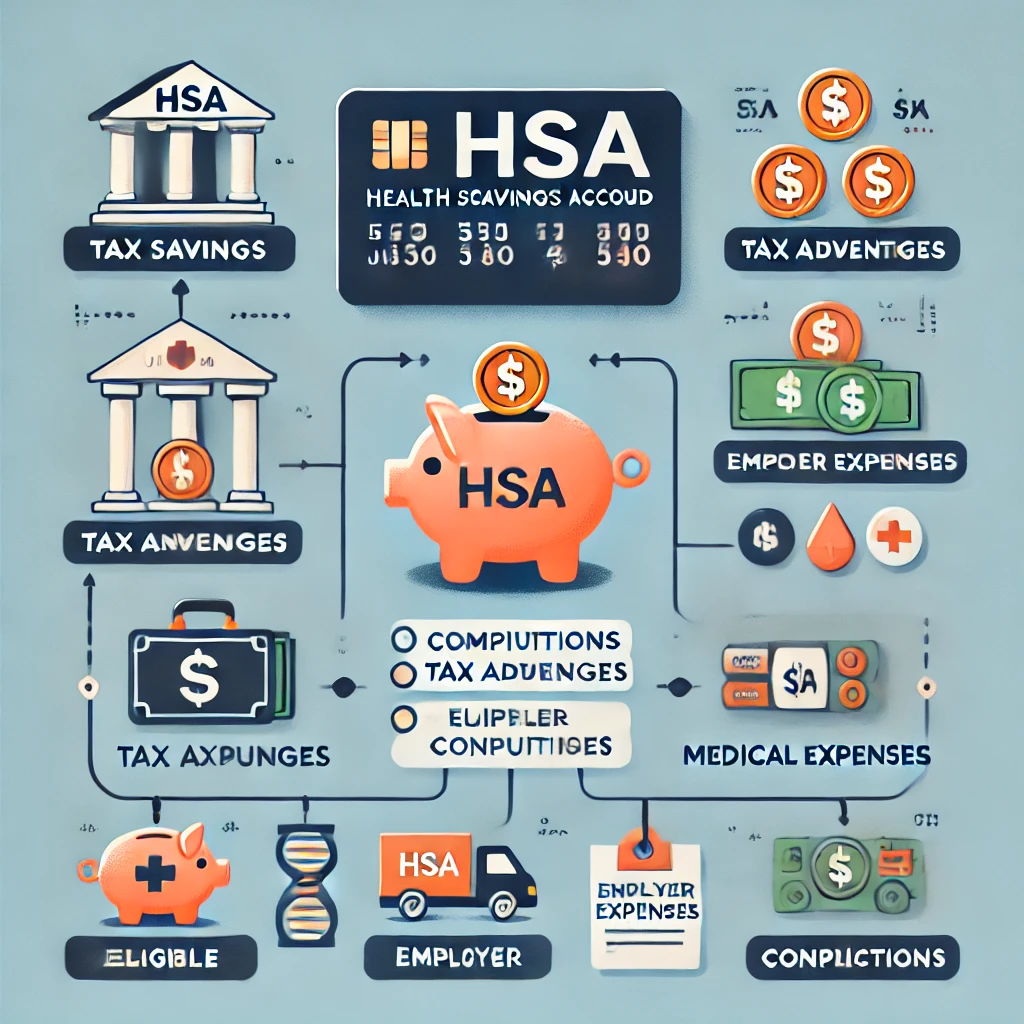
HSA Accounts
Health Savings Accounts (HSAs) are a powerful financial tool in the United States that can help you save money on medical expenses while also reducing your taxable income. HSAs are designed to complement high-deductible health plans (HDHPs) and offer tax advantages that make them an attractive option for those looking to manage their healthcare costs. Here’s everything you need to know about how HSAs work, their benefits, and how to make the most of them.
1. What Is an HSA?
An HSA (Health Savings Account) is a tax-advantaged savings account that individuals with a qualifying high-deductible health plan (HDHP) can use to pay for qualified medical expenses. The money in your HSA belongs to you, and any unused funds roll over from year to year.
Who Can Open an HSA?
To qualify for an HSA, you must:
- Be enrolled in an HDHP that meets the minimum deductible requirements set by the IRS.
- Not be enrolled in Medicare.
- Not be claimed as a dependent on someone else’s tax return.
2. How Does an HSA Work?
a. Contributing to Your HSA
- Contributions can be made by you, your employer, or both.
- The 2024 annual contribution limits set by the IRS are:
- $4,150 for individuals.
- $8,300 for families.
- If you’re age 55 or older, you can contribute an additional $1,000 as a catch-up contribution.
b. Tax Advantages
HSAs offer triple tax benefits:
- Tax-Deductible Contributions: Contributions reduce your taxable income, lowering your tax bill.
- Tax-Free Growth: Earnings from interest or investments grow tax-free within the account.
- Tax-Free Withdrawals: Funds withdrawn to pay for qualified medical expenses are not taxed.
c. Using HSA Funds
You can use HSA funds to pay for qualified medical expenses, such as:
- Doctor visits, copays, and deductibles.
- Prescription medications.
- Vision care, including glasses and contact lenses.
- Dental care, such as cleanings, fillings, and braces.
- Certain over-the-counter medications and medical supplies.
- For a full list of eligible expenses, refer to IRS Publication 502.
3. What Happens to Unused Funds?
One of the biggest advantages of an HSA is that any unused money remains in the account at the end of the year. It doesn’t expire, and you can continue to use it indefinitely. Over time, this feature allows you to build a healthcare savings nest egg for future expenses.
4. How HSAs Differ from FSAs (Flexible Spending Accounts)
Many people confuse HSAs with FSAs, but they work differently:
| Feature | HSA | FSA |
|---|---|---|
| Eligibility | Requires enrollment in an HDHP | No HDHP required |
| Ownership | Owned by the individual | Owned by the employer |
| Funds Rollover | Unused funds roll over annually | Use-it-or-lose-it rule applies |
| Contribution Limits | $4,150 (individual), $8,300 (family) in 2024 | $3,050 (2024 limit) |
5. Investing with an HSA
Many HSA providers allow you to invest the money in your account in mutual funds, ETFs, or other investment options once your balance reaches a certain threshold (often $1,000).
- Why Invest?: If you don’t need the funds for current medical expenses, investing your HSA balance can help it grow tax-free for future healthcare needs or even retirement.
- Tax Advantage in Retirement: After age 65, HSA funds can be withdrawn for any purpose without penalty (though non-medical withdrawals are taxed as income).
6. How to Open an HSA
Opening an HSA is simple, and you can do so through:
- Your Employer: Many employers that offer HDHPs also provide HSA options and may even contribute to your account.
- Banks or Financial Institutions: Independent HSA providers, such as Fidelity, Lively, or HealthEquity, offer HSAs with competitive features like investment options and low fees.
7. Benefits of an HSA
a. For Healthcare Savings
HSAs allow you to set aside money for both short-term and long-term healthcare expenses, ensuring you’re prepared for medical costs without dipping into your regular income.
b. For Retirement Planning
- Think of an HSA as a “backup retirement account” for medical costs in your golden years. Healthcare expenses in retirement can be significant, and an HSA can help cover them tax-free.
- After age 65, funds can also be used for non-medical expenses, although they’ll be taxed as regular income.
c. Employer Contributions
Many employers contribute to employees’ HSAs, essentially giving you free money to help cover medical expenses.
d. Portability
Your HSA stays with you even if you change jobs, switch health plans, or retire.
8. Potential Drawbacks
a. Requires an HDHP
You can only open an HSA if you’re enrolled in a high-deductible health plan, which may not work for everyone, especially if you have high medical expenses.
b. Penalties for Non-Medical Use
If you withdraw funds for non-medical expenses before age 65, you’ll face a 20% penalty plus income taxes on the withdrawal.
c. Contribution Limits
The IRS sets annual contribution limits, which may restrict how much you can save in your HSA.
9. Common Questions About HSAs
Can I Use HSA Funds for Family Members?
Yes, you can use HSA funds to cover qualified medical expenses for your spouse and dependents, even if they’re not covered by your HDHP.
Do HSAs Expire?
No, HSAs don’t expire. Unused funds roll over from year to year, and the account remains yours, even if you change jobs or stop contributing.
What Happens to My HSA If I Switch to a Non-HDHP?
You can no longer contribute to your HSA, but the money already in your account can still be used for qualified medical expenses.
Final Thoughts
Health Savings Accounts (HSAs) are an excellent way to save for medical expenses, reduce your taxable income, and even plan for retirement. Whether you’re looking to cover immediate healthcare costs or invest for the future, an HSA offers unmatched flexibility and tax benefits. If you’re enrolled in a high-deductible health plan, opening an HSA is a smart financial move.
For more tips on managing healthcare expenses and financial planning, check out helpful guides to take control of your health and money.
Добавить комментарий